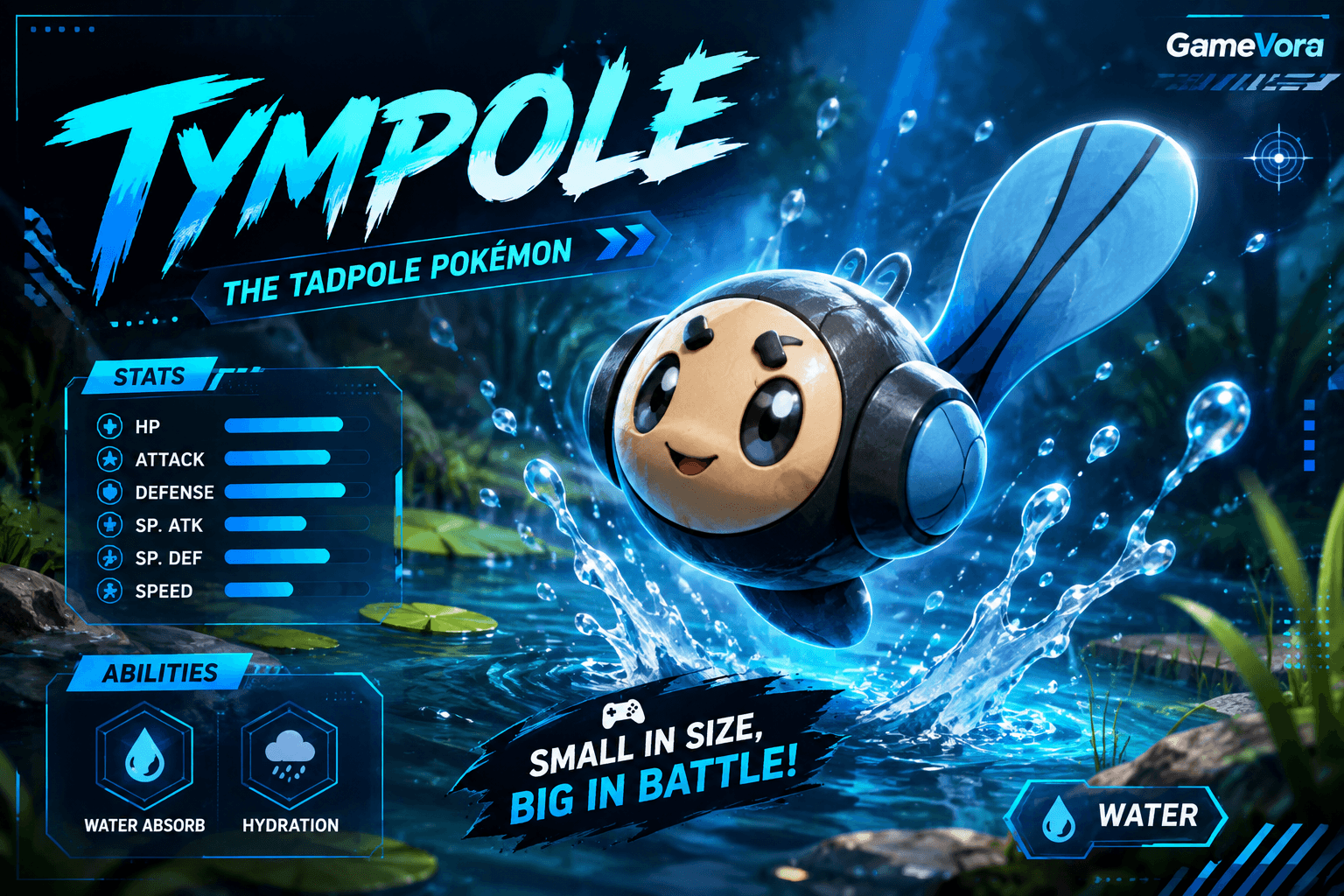
Tympole is one of those Pokémon that can look simple at first glance but becomes much more interesting once you learn how it behaves and evolves. Introduced in Generation V, this small Water-type Pokémon is based on a tadpole and has a surprisingly unusual way of communicating. Rather than relying on sounds that people can easily hear, Tympole uses vibrations in its cheeks to produce sound waves and communicate with others of its kind. Its journey does not stop there, either. As it grows, Tympole evolves into Palpitoad and eventually into Seismitoad, turning a tiny tadpole-like Pokémon into a much larger Water/Ground-type Pokémon.
Quick Bio: Tympole
| Attribute | Details |
|---|---|
| Pokémon | Tympole |
| National Pokédex | #535 |
| Type | Water |
| Category | Tadpole Pokémon |
| Generation | Generation V |
| Height | 0.5 m (1′08″) |
| Weight | 4.5 kg (9.9 lbs.) |
| First Evolution | Palpitoad |
| Evolution Level | Level 25 |
| Final Evolution | Seismitoad |
| Second Evolution Level | Level 36 |
| Abilities | Swift Swim, Hydration |
| Hidden Ability | Water Absorb |
What Is Tympole?
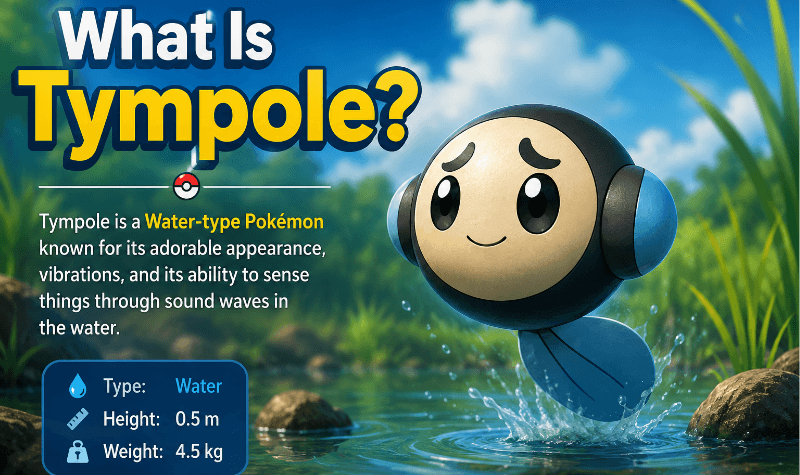
The basic details above place Tympole firmly among the smaller Pokémon introduced in the Unova region. Its official Pokédex information lists it as a Water-type Pokémon with a height of 0.5 meters and a weight of 4.5 kilograms. Its regular abilities include Swift Swim and Hydration, while Water Absorb is available as its Hidden Ability.Tympole is a Water-type Pokémon from Generation V, first appearing in Pokémon Black and White. It carries National Pokédex number #535 and belongs to the Tadpole Pokémon category. Although its body is small and round, Tympole has several design details that connect it to both tadpoles and sound. Its face has large black eyes and a wide mouth, while the rounded structures on either side of its head are closely associated with the vibrations it uses to communicate.One of the most interesting things about Tympole is that its communication system is not simply a cute detail added to its design. Pokédex descriptions explain that Tympole vibrates its cheeks to produce sound waves that humans cannot hear. The rhythm of those waves allows Tympole to communicate with others of its kind, including warning them when danger is nearby. The official Pokémon Pokédex also describes Tympole singing in high-pitched voices beneath the water, producing graceful ripples on the surface.That gives Tympole more personality than its small size might suggest. It is not simply a tadpole-shaped Pokémon swimming around in ponds. Its behavior is closely connected to sound, rhythm, communication, and life in the water.
What Does Tympole Look Like?
Tympole has a very recognizable appearance. Its body is mostly spherical, with no visible arms or legs, and it has a long blue tail that resembles the tail of a real tadpole. Its face is tan, while its body is darker, creating a strong contrast between the head and the rest of its shape. Large black eyes and a distinctive mouth give Tympole a somewhat expressive appearance.The rounded structures on the sides of its head are perhaps its most noticeable feature. These cheek-like areas are important because Tympole uses them to create vibrations and sound waves. Even its eyebrows contribute to the sound-related theme of its design, resembling musical notes.Its design also makes more sense when viewed alongside its evolutions. Tympole is the starting point of a line that eventually leads to Seismitoad, and the concepts of water, vibration, sound, and amphibian-like features continue through the evolution line.
Why Does Tympole Use Sound Waves?
Why would a tiny Water-type Pokémon need such an unusual communication method?Tympole uses vibrations in its cheeks to create sound waves that humans and other Pokémon species cannot hear. These waves can be used as a form of communication among Tympole. According to its Pokédex descriptions, the rhythm of the sounds can help them communicate and warn one another about danger.This ability is one of the details that separates Tympole from many other early-stage Pokémon. Instead of giving it an ordinary cry or simple behavior, the games give it a communication system that fits naturally with its physical design.The connection becomes even clearer when looking at Tympole’s association with music. Its eyebrows resemble musical notes, and its name is commonly understood to reference sound-related terms such as “tympanum” or “timpani,” combined with “tadpole.”
Tympole’s Type, Abilities, and Battle Traits
Tympole is a pure Water-type Pokémon. In battle, this gives it access to Water-type moves while also making it weak to Grass- and Electric-type attacks. Its official Pokédex lists Swift Swim and Hydration among its abilities.Swift Swim is especially useful in rainy conditions because it increases the Pokémon’s Speed. Hydration has a different purpose: it can cure status conditions when the Pokémon is affected by rain. Tympole also has Water Absorb as its Hidden Ability, which gives it an interesting defensive option against Water-type attacks.Its base stats show a Pokémon designed more for speed than raw physical toughness. Tympole has a base Speed of 64, while its overall base stat total is 294. Its defenses are relatively modest, so trainers generally benefit from considering its role rather than expecting it to overpower opponents through brute force.
When Does Tympole Evolve?
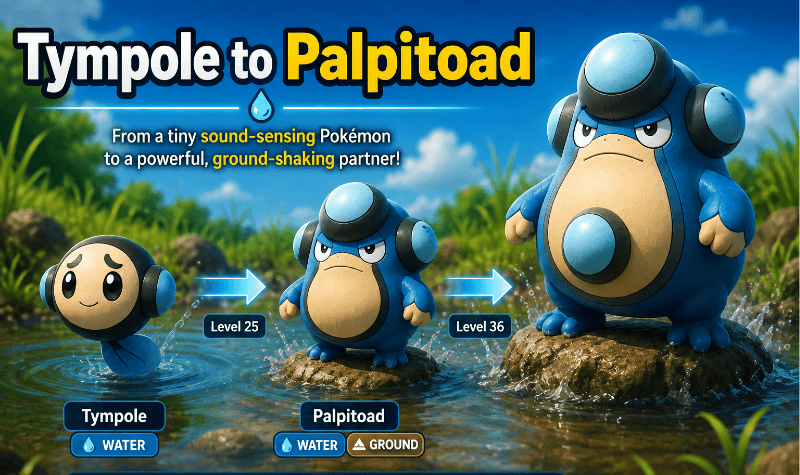
One of the most common questions about Tympole is simple: when does Tympole evolve?In the main Pokémon games, Tympole evolves into Palpitoad at level 25. This is a straightforward level-based evolution, so there is no special stone, trade, friendship requirement, or unusual condition needed to trigger the first transformation.The evolution changes more than Tympole’s appearance. Palpitoad becomes a Water/Ground-type Pokémon, adding a second typing that Tympole does not have. The evolution line therefore moves from a small Water-type tadpole into a more capable amphibious Pokémon.After reaching the next stage, Palpitoad evolves into Seismitoad at level 36. This completes the three-stage line that begins with Tympole.
Tympole to Palpitoad
The first step in the evolution line is Tympole → Palpitoad.At level 25, Tympole evolves into Palpitoad. The change is easy to notice because Palpitoad has a much more developed amphibian appearance. Its body is larger and more frog- or toad-like, while the simple tadpole shape of Tympole is left behind.The typing also changes. While Tympole is Water-type, Palpitoad becomes Water/Ground. That second type gives the middle stage a different battle identity and connects more strongly with the muddy, amphibian-inspired side of the design.For trainers using Tympole during a playthrough, this evolution can be an important point. Instead of remaining a small early-stage Pokémon, Palpitoad begins to feel like a more complete member of the team.
Palpitoad to Seismitoad
The second evolution occurs at level 36, when Palpitoad becomes Seismitoad. Seismitoad remains a Water/Ground-type Pokémon, but its appearance becomes considerably larger and more powerful.Seismitoad also continues the evolution line’s focus on vibrations. Its design incorporates bumps and powerful physical features that connect to the idea of using vibrations as a source of strength. Its Pokédex entries describe it using vibrations in battle and developing considerable physical power.This makes the complete evolution line feel connected rather than random. Tympole begins with communication through vibration, Palpitoad develops the amphibian concept, and Seismitoad takes the vibration theme into a much more powerful form.
Tympole Evolution Line Compared
Looking at all three Pokémon together makes the progression easier to understand.Tympole is the small starting point. It is a Water-type tadpole Pokémon built around swimming, sound, and communication.
Palpitoad is the middle stage. It gains the Water/Ground typing and moves further away from the simple tadpole shape.Seismitoad is the final evolution. It keeps the Water/Ground typing but becomes a much larger and more powerful Pokémon, with its design emphasizing vibrations and physical strength.
The evolution can therefore be summarized as:
Tympole → Palpitoad → Seismitoad
Level 25: Tympole evolves into Palpitoad.
Level 36: Palpitoad evolves into Seismitoad.
Tympole’s Moves and Battle Potential
Tympole has access to a variety of moves that fit its Water-type identity while also giving it some useful options. Depending on the generation and game, its learnset has included moves such as Bubble Beam, Mud Shot, Aqua Ring, Muddy Water, Rain Dance, and Hydro Pump.The move selection becomes particularly interesting when combined with its abilities. A Tympole with Swift Swim can take advantage of rain, while Rain Dance can create the weather condition that makes Swift Swim especially useful. Hydration can also benefit from rain by curing status conditions.Tympole is not necessarily designed to dominate battles by itself. Its relatively low defensive stats mean that trainers need to think about matchups and timing. Still, it can be a useful Pokémon early in a game, particularly when its Water-type moves are effective against the opponent.As it evolves, its battle options become broader. The addition of the Ground typing in Palpitoad and Seismitoad gives the evolution line a different set of offensive and defensive considerations.
Is Tympole Worth Training?
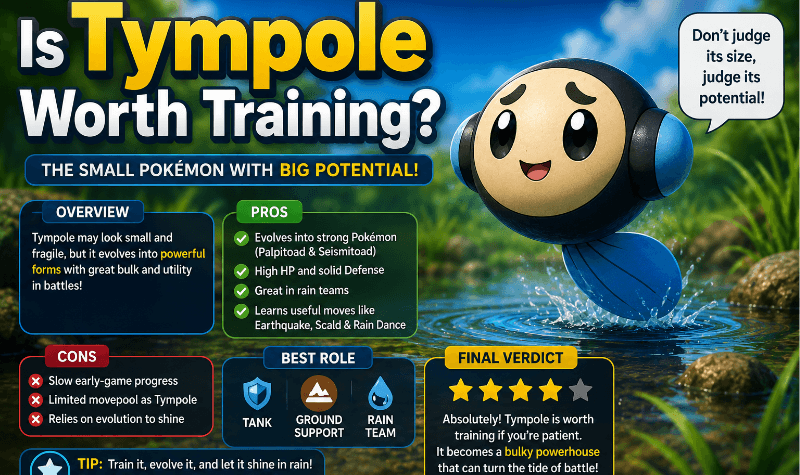
Is Tympole worth keeping on a team?For many players, the answer can be yes, particularly if they enjoy Pokémon that develop significantly through evolution. Tympole starts as a small and relatively modest Pokémon, but its evolution line eventually leads to Seismitoad. That makes training Tympole feel more rewarding than simply judging it by its first-stage appearance.Its abilities can also give it useful utility. Swift Swim fits naturally with rain-based strategies, while Water Absorb can provide an interesting defensive advantage.Of course, whether Tympole is worth training depends on the player’s team. A trainer who already has a strong Water-type may have less reason to use it. But for someone looking for a Pokémon with a distinctive design and a three-stage evolution line, Tympole is an appealing choice.
The Inspiration Behind Tympole
Tympole’s design appears to combine several ideas rather neatly. The most obvious inspiration is a tadpole, which explains its rounded body and long tail. But there is another important theme running through its appearance: sound.Bulbapedia notes that Tympole may combine references to timpani or tympanum with the word “tadpole.” The tympanum is an eardrum-like structure, while timpani are musical instruments. The rounded cheek structures and musical-note-like eyebrows reinforce this sound-based concept.This is a good example of how Pokémon designs often work on more than one level. At first, Tympole looks like a simple cartoon tadpole. Once its Pokédex behavior and name are considered, the sound theme becomes much easier to notice.
Tympole in the Pokémon Games
Tympole made its debut in Generation V, meaning it was introduced with the Unova games. It was not available in Pokémon games before Generation V. Later appearances expanded its presence beyond its original games, including Pokémon Sword and Shield.Its presence across different Pokémon games has allowed players to experience the entire evolution line in different settings. The core identity remains the same: a Water-type tadpole that evolves first into Palpitoad and then into Seismitoad.Tympole has also appeared in Pokémon’s wider media, including the animated series and the Trading Card Game. Its unusual communication ability has helped make it recognizable beyond the main video games.
Tympole’s Role in the Evolution Story
What makes Tympole particularly enjoyable is the way its evolution tells a visual story.The first stage looks like a tadpole. It is small, rounded, and focused on life in the water. Its communication abilities give it a distinctive personality.Palpitoad moves into a more developed amphibian form. The body becomes more substantial, and the Water/Ground typing gives it a new identity.Finally, Seismitoad becomes a powerful-looking toad Pokémon. The evolution no longer resembles a tiny tadpole, but the original themes have not disappeared. Vibrations remain an important part of the concept, creating a connection between the beginning and end of the line.That kind of progression is one reason the Tympole family works so well as a three-stage evolution.
Interesting Facts About Tympole
There are several small details that make Tympole worth a closer look.First, Tympole’s National Pokédex number is 535, placing it between Conkeldurr and Palpitoad in the National Pokédex sequence.Second, its official height is only 0.5 meters, and it weighs 4.5 kilograms. That makes it considerably smaller than its final evolution, reinforcing the dramatic physical change across the line.Third, its communication is based on sound waves that people cannot hear. This is not merely a battle gimmick; it is part of Tympole’s natural behavior in the Pokémon world.Finally, all three members of the evolution family—Tympole, Palpitoad, and Seismitoad—are associated with the Tadpole Pokémon classification.
Frequently Asked Questions About Tympole
What type is Tympole?
Tympole is a Water-type Pokémon. Its evolutions, Palpitoad and Seismitoad, become Water/Ground types.
What number is Tympole in the National Pokédex?
Tympole is National Pokédex #535.
What does Tympole evolve into?
Tympole evolves into Palpitoad, which later evolves into Seismitoad.
What level does Tympole evolve?
Tympole evolves into Palpitoad at level 25.
What level does Palpitoad evolve?
Palpitoad evolves into Seismitoad at level 36.
Is Tympole a Water/Ground Pokémon?
No. Tympole itself is pure Water-type. Water/Ground is the typing of its evolutions, Palpitoad and Seismitoad.
What abilities can Tympole have?
Tympole can have Swift Swim or Hydration as its regular abilities. Water Absorb is its Hidden Ability.
Why does Tympole vibrate its cheeks?
Tympole uses vibrations in its cheeks to produce sound waves. These sounds help it communicate with other Tympole and warn them about danger.
Can humans hear Tympole’s communication?
The Pokédex describes Tympole’s communication sounds as being too high-pitched for humans to hear.
Is Tympole based on a real animal?
Tympole is primarily inspired by a tadpole, while its design also incorporates ideas related to sound and musical instruments.
Is Tympole a good Pokémon to train?
Tympole can be worthwhile to train, especially for players who want to eventually use Palpitoad or Seismitoad. Its abilities and Water typing can be useful, while its evolution gives it additional options.
Final Thoughts on Tympole and Its Evolution
Tympole may begin its journey as a tiny tadpole-shaped Pokémon, but there is more going on beneath that simple design than first meets the eye. Its unusual communication system, sound-based theme, Water typing, and three-stage evolution give it a clear identity within the Pokémon world.The progression from Tympole to Palpitoad and finally to Seismitoad is also one of the more noticeable transformations among Generation V Pokémon. Starting at level 25, Tympole becomes Palpitoad, and at level 36, the line reaches its final form, Seismitoad.What makes Tympole memorable is not simply the fact that it evolves. Its design, behavior, abilities, and evolution all connect around the same amphibian and vibration themes. For players discovering the Unova Pokémon for the first time—or revisiting them years later—Tympole remains a small Pokémon with a surprisingly distinctive story.