Podcasters spend a lot of energy making a show sound good, but far less time figuring out who’s actually listening to it. That gap is exactly what BackToFrontShow was built to close. It positions itself as an audience-intelligence platform for podcasters, going past simple download counts and into the kind of listener behavior data that shapes real content decisions — things like where an audience is located, what device they’re using, how far into an episode they typically listen, and how engaged they are episode over episode. For anyone who has outgrown basic host-provided stats and wants a fuller picture, understanding BackToFrontShow pricing before signing up is the sensible first step, since the plans differ quite a bit in both cost and depth.
| Quick Facts | Details |
|---|---|
| Platform type | Podcast analytics and audience intelligence |
| Core offering | Listener demographics, engagement tracking, device analytics, geographic mapping |
| Pricing model | Tiered subscription (Basic, Pro, Enterprise) |
| Starting price | $1,200 per month |
| Billing | Monthly, per published rate |
| Best suited for | Independent shows to large media networks |
What BackToFrontShow Actually Does
Before getting into numbers, it helps to understand what you’re paying for. BackToFrontShow works by connecting to a podcast’s existing distribution feed rather than asking creators to switch hosting providers. Once connected, it collects listener data and organizes it into a dashboard covering audience characteristics, engagement patterns, retention, and geographic spread. Reviewers and users describe the platform as useful for spotting where drop-off happens in an episode, which markets an audience is concentrated in, and which devices listeners prefer — details that go well beyond a simple download count. According to the company’s own figures, the platform has processed more than a million minutes of podcast audio and analyzed several million listener data points across more than a dozen countries, with users reporting noticeable gains in audience engagement after acting on the insights. Whether those numbers hold up for every account will vary, but they give a sense of the scale the tool is designed to operate at.
BackToFrontShow Pricing: The Three Tiers
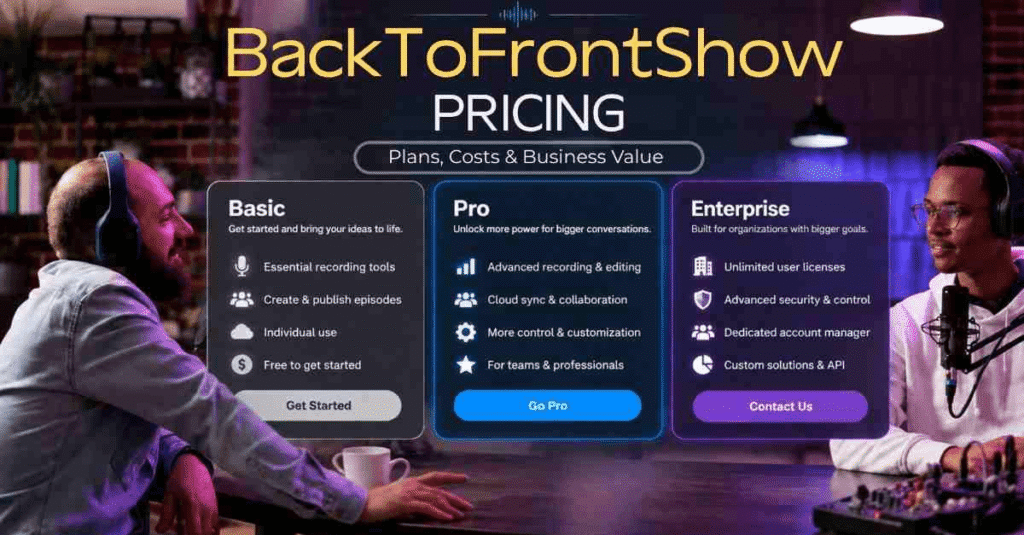
BackToFrontShow currently lists three pricing tiers on its official pricing page: Basic, Pro, and Enterprise. The first two have published monthly rates, while the third is quote-based. This structure is fairly typical of B2B analytics software — a lower tier to prove value, a mid tier for teams that need more depth, and a custom tier for organizations with complex needs. What makes BackToFrontShow pricing worth examining closely is the size of the jump between tiers, since the difference between Basic and Pro is not a small bump but a full three times the monthly cost.
Basic Plan: $1,200 Per Month
The Basic plan is the entry point into BackToFrontShow, and at $1,200 a month it is already priced well above most beginner-friendly podcast tools. This tier is built around the core analytics package: audience profiling, engagement tracking, and standard reporting. A solo podcaster or a small independent show would use this plan mainly to understand who is listening, from which regions, and on which devices, without needing anything more elaborate than that. It is a reasonable starting point for a creator who is serious about growth but not yet managing a team or multiple shows. The trade-off is that Basic tends to cap out on things like advanced segmentation, integration options, and the number of users who can access the dashboard, so shows that scale quickly often find themselves needing more within a year or two.
Pro Plan: $3,600 Per Month
The Pro plan sits at $3,600 a month, three times the price of Basic, and it is aimed at growing shows or small media teams managing more than one podcast. Where Basic gives a general picture of the audience, Pro is built for deeper segmentation and closer to real-time reporting, along with a broader set of integrations that larger teams tend to need for connecting their existing workflow. This tier makes the most sense for teams where the analytics genuinely feed into decisions — episode scheduling, guest selection, advertising rates, or sponsorship pitches that rely on solid audience data. For a show still figuring out its format or its audience, paying three times more for deeper granularity may not be worth it yet. For a team that already has advertisers asking pointed questions about listener demographics, it often is.
Enterprise Plan: Custom Pricing
The Enterprise tier is not listed with a fixed number, and prospective customers are asked to contact the company directly for a quote. This is standard for software aimed at large media companies and networks, where the cost depends heavily on how many shows are being tracked, what CRM or internal systems need to connect with the platform, and what kind of support or service-level agreement is required. Organizations considering Enterprise are usually well past the point of testing the water — they already know analytics matter and are looking for a system that scales across many shows at once, often with dedicated account support. Anyone reaching this stage should go in with a clear sense of how many shows they need covered and what integrations are non-negotiable, since those two factors tend to drive the final quote more than anything else.
Hidden Costs and Things Worth Watching
Published monthly rates rarely tell the whole story, and BackToFrontShow pricing is no exception. It is worth asking about onboarding or setup work, especially for teams connecting multiple feeds or integrating with existing CRM tools, since implementation time can add real cost even when the sticker price doesn’t change. Overage charges are another point to clarify upfront — what happens if a show adds more episodes, more users, or more data than the plan technically covers. Contract terms matter too: whether billing is strictly monthly or whether an annual commitment brings the rate down, and what the cancellation process actually looks like if the platform turns out not to be the right fit. None of this is unusual for analytics software in this price range, but it is the kind of detail that is easy to overlook when comparing plans side by side.
How the Pricing Compares
Against budget podcast analytics tools, many of which are free or cost a fraction of even the Basic plan, BackToFrontShow sits firmly in premium territory. That positioning is deliberate — the platform is not competing with basic host-provided stats, it is competing with the kind of audience intelligence tools that larger media operations already budget for. Shows that only need download counts and rough listener geography will likely find cheaper alternatives sufficient. Shows that need to justify ad rates, pitch sponsors with real data, or make programming decisions based on retention curves are the ones for whom the higher price tends to make sense.
Which Plan Should You Choose?
The right plan mostly comes down to four questions: how large is your show, how many people need access to the dashboard, how much do your current decisions already lean on data, and what is your actual budget for tools versus production. A solo creator testing whether deeper analytics change anything about their show should start with Basic rather than jumping straight to Pro. A small team already running ads or pitching sponsors will likely get more value out of Pro’s deeper segmentation. Enterprise only makes sense once a network is managing enough shows that a custom setup pays for itself. The general advice that comes up again and again from people who have actually used the platform is simple — start smaller than you think you need, and upgrade once the free or entry-level insights clearly aren’t enough anymore.
Frequently Asked Questions
Is BackToFrontShow pricing negotiable? For the Basic and Pro tiers, pricing appears fixed at the published rate. Enterprise pricing is explicitly custom, so there is room to negotiate based on scale and contract length.
Does BackToFrontShow offer a free trial? The official pricing page lists Basic, Pro, and Enterprise as paid tiers with no published free plan, so anyone interested should confirm directly with the company whether a trial or demo is available before committing.
What’s the difference between Basic and Pro besides price? Basic covers core audience profiling and engagement tracking, while Pro adds deeper segmentation, closer to real-time data, and more integration options — better suited to teams making decisions based on the data rather than just reviewing it occasionally.
Is BackToFrontShow worth it for a small independent podcast? It depends on how much the show already relies on data. A new or small show may find the Basic plan’s cost hard to justify next to free alternatives, while a growing show with sponsorship goals may see it pay for itself.
How is Enterprise pricing calculated? It is based mainly on the number of shows tracked, the integrations required, and the level of support needed, rather than a flat per-seat or per-show rate.
Are there additional fees beyond the monthly plan cost? Possibly, depending on onboarding needs, integrations, or usage beyond what a plan covers — it is worth confirming these details before signing a contract.
Pricing details for BackToFrontShow can change, so it’s worth checking the official site directly before making a final decision, particularly for the Enterprise tier where quotes depend on individual account needs.
