I still remember the first time someone laughed at my team for having a Ralts on it. It was early game, the little thing had barely any HP, and next to a Charizard or a Gardevoir already halfway evolved, it looked like a joke. That’s usually how it goes with Ralts. Nobody picks it because it’s flashy. Nobody screenshots it for a highlight reel. But somewhere between that first weak little Psychic type and the powerhouse it eventually becomes, I got attached, and I’ve never really let go since.
| Quick Bio: Ralts | |
|---|---|
| National Pokédex No. | #280 |
| Type | Psychic / Fairy (Psychic only in Gen III–V) |
| Height | 1’4″ (0.4 m) |
| Weight | 14.5 lbs (6.6 kg) |
| Abilities | Synchronize, Trace, Telepathy (Hidden) |
| Evolves Into | Kirlia (Level 20) → Gardevoir or Gallade |
| Egg Groups | Amorphous, Human-Like |
| First Appearance | Pokémon Ruby & Sapphire (Gen III) |
What Exactly Is Ralts?
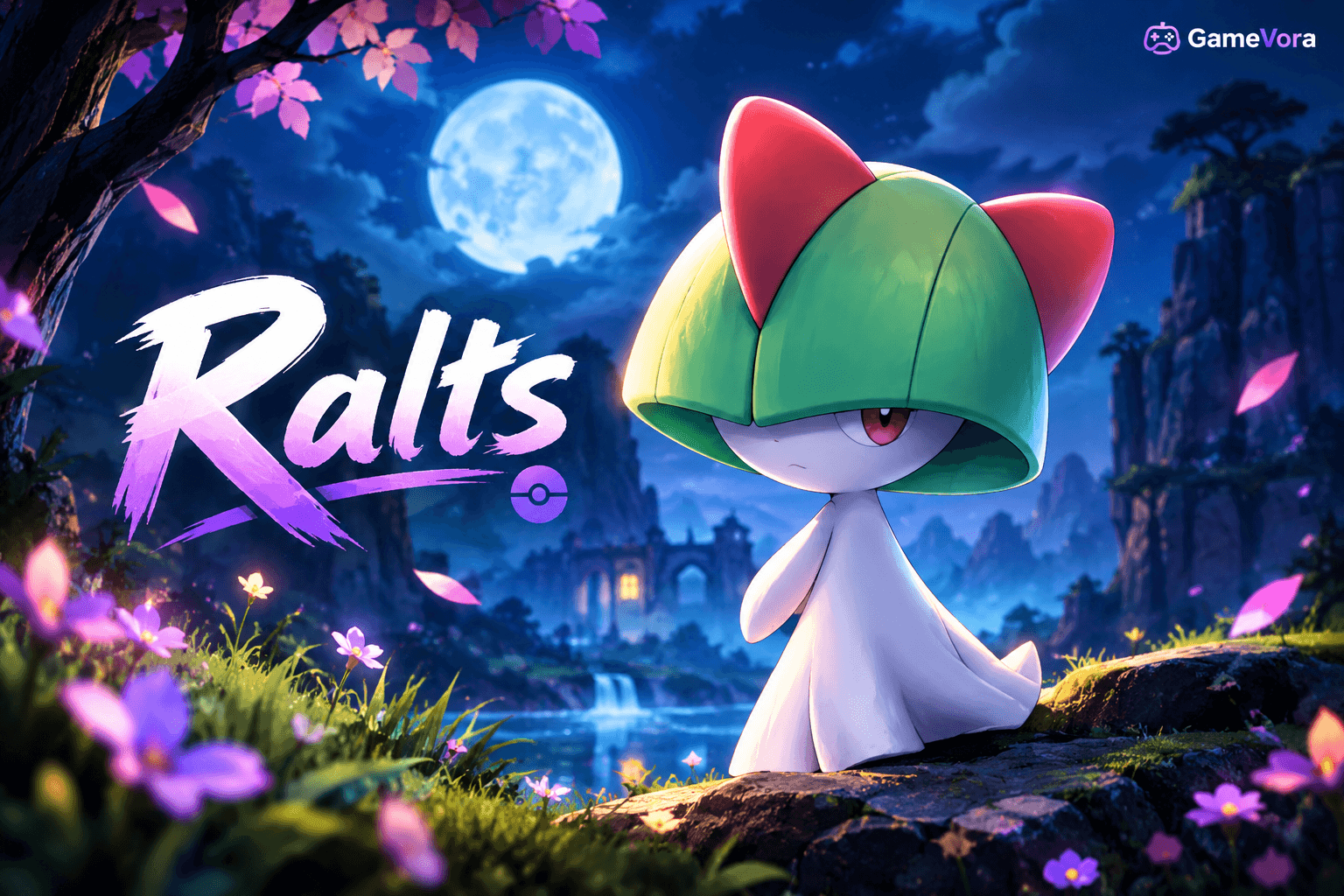
Ralts is a small, pale green and white Pokémon that debuted back in Generation III, and honestly, it looks nothing like a fighter. It has a rounded body, short legs shaped almost like a dress, and a bowl-cut hairstyle that covers part of its face. What stands out most, though, are the two flat red horns on top of its head — one larger toward the front, one smaller behind it. Those horns aren’t just decoration. They’re how Ralts reads emotion, in people and in other Pokémon, which is a strange and quietly beautiful thing for a video game creature to be built around.

The Story Behind Ralts, Not Just the Stats
There’s a reason Ralts feels different from most early-route Pokémon, and it comes down to its backstory. It’s described as extremely sensitive, timid around strangers, and prone to hiding when it senses negative feelings nearby. But when it picks up on warmth or happiness from someone close by, its whole body responds, and it will move closer to that person almost on instinct. Fans and long-time players have pointed out that Ralts seems to be modeled on the idea of a young, emotionally open child, and once you notice that, the design choices make a lot more sense. The hair covering its eyes, the shy behavior, the way it reacts to kindness before anything else — none of that reads as random.

How Ralts Evolves, and Why the Line Matters
This is where Ralts earns its keep. At level 20, it evolves into Kirlia, a taller, more elegant version of the same idea, still carrying that same emotional sensitivity but with more presence. From there, the line splits, and this is one of the more interesting branching evolutions in the whole franchise. A Kirlia will become Gardevoir simply by leveling up, but if that Kirlia happens to be male, there’s another path: expose it to a Dawn Stone, and it becomes Gallade instead, a completely different Pokémon in both look and fighting style. Gardevoir leans elegant and defensive, while Gallade is sharp, fast, and built around close combat. Very few Pokémon offer that kind of fork in the road, and fewer still tie it to something as specific as gender plus an item, which makes catching and raising a Ralts feel like an actual decision rather than a formality.

Battling With Ralts Isn’t a Waste of Time
People assume Ralts is only worth catching for what it becomes, and while that’s part of the appeal, its abilities deserve a mention too. Trace, its signature ability, lets it copy whatever ability an opposing Pokémon is using the moment it enters battle, which can turn an unassuming Ralts into something briefly unpredictable. Synchronize works differently, passing burns, poison, or paralysis right back onto whatever inflicted them, a quiet kind of payback. Even its hidden ability, Telepathy, plays into the same theme by protecting it from friendly fire in double battles. None of these abilities are loud or overpowered. They’re clever, situational, and reward a player who’s actually paying attention, which fits everything else about this Pokémon.
Why a Pokémon Without Flash Still Wins Me Over
Here’s the thing about Ralts that took me a while to put into words. Most Pokémon that grab attention early do it because they hit hard right away or look intimidating from the first encounter. Ralts does the opposite. It starts weak, looks a little strange, and asks you to stick with it through a rough early stretch before it gives anything back. But that’s exactly what makes the payoff land. Watching a fragile little Ralts turn into a Gardevoir or Gallade feels earned in a way that catching an already-strong Pokémon never quite does. It’s less about power and more about growth, and that’s a rare thing for a game mechanic to actually make you feel.
Common Questions About Ralts
Is Ralts a good Pokémon to use early in the game? It can be, though it takes patience. Its base stats are on the lower end, particularly HP and Defense, so it needs some support until it evolves into Kirlia.
What’s the difference between Gardevoir and Gallade? Gardevoir evolves from any Kirlia through leveling and plays more like a special attacker with strong defensive utility. Gallade only comes from a male Kirlia exposed to a Dawn Stone and fights up close as a physical attacker instead.
Why does Ralts hide from people sometimes? According to its in-game lore, Ralts can sense emotions through the horns on its head, and it tends to stay hidden when it picks up on negative feelings nearby, only approaching people it senses are happy or kind.
Can Ralts be shiny? Yes, Ralts has a shiny form, though like most Pokémon it’s rare to encounter naturally and often sought out through specific hunting methods or events.
What type is Ralts? In its original Generation III release, Ralts was a pure Psychic type. Starting in Generation VI, it gained the Fairy type as well, making it Psychic/Fairy in current games.
Read more: Caterpie Explained: Evolution, Abilities, and Interesting Facts