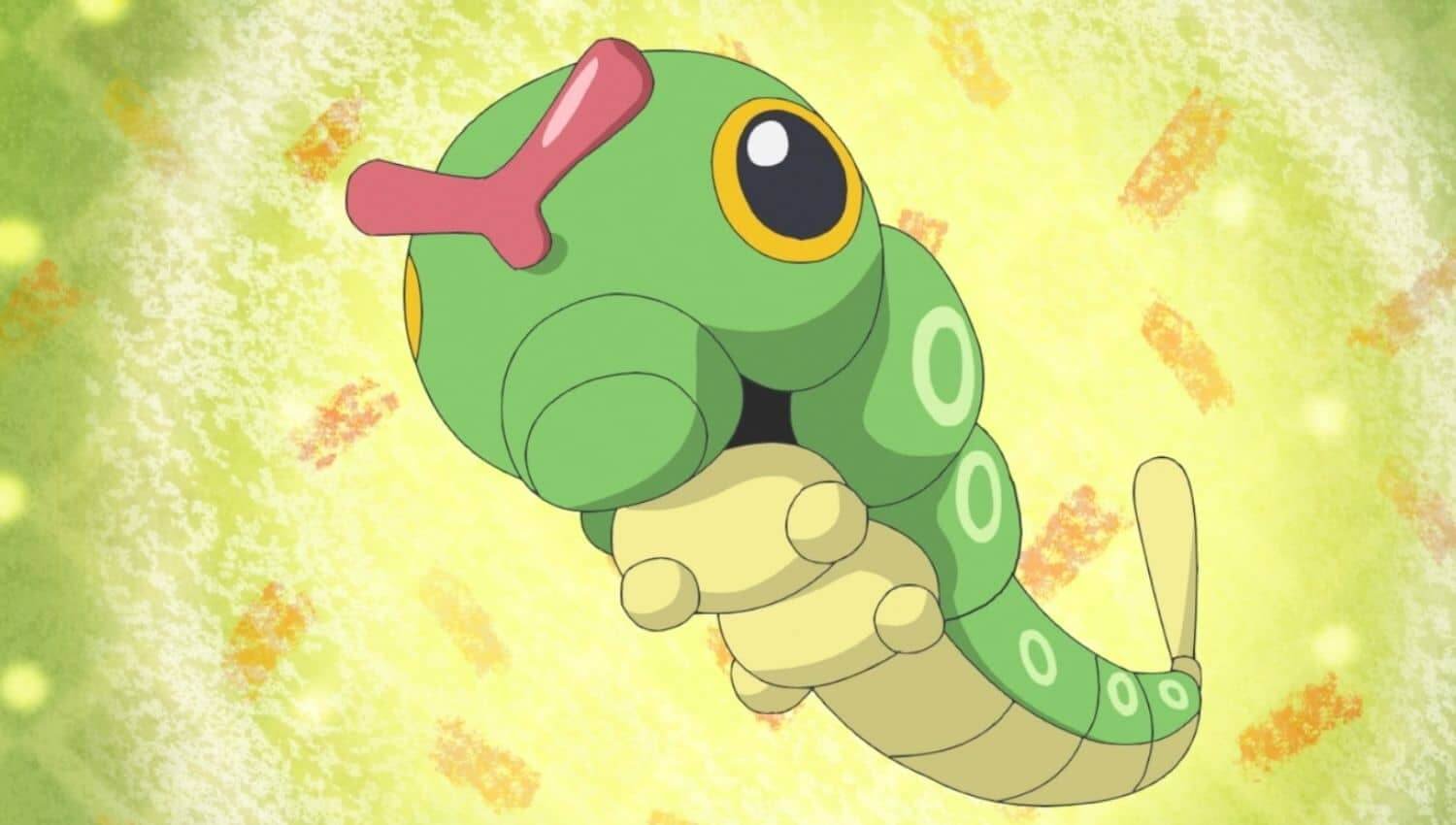
Caterpie is one of those Pokémon that looks simple at first but becomes more interesting the closer you look. Introduced in Generation I, this small Bug-type Pokémon is recognized as Pokédex #0010 and belongs to the Worm category. Its green body, red antenna, and yellow markings give it an appearance inspired by a young caterpillar, while its abilities and evolution make it an important early Pokémon in the series. Caterpie is also memorable because its journey does not end with its first form—it develops into Metapod and eventually Butterfree. The official Pokédex lists Caterpie as 0.3 meters tall and weighing 2.9 kilograms.
| Caterpie Quick Facts | Details |
|---|---|
| Pokédex Number | #0010 |
| Type | Bug |
| Category | Worm Pokémon |
| Height | 0.3 m |
| Weight | 2.9 kg |
| Ability | Shield Dust |
| Hidden Ability | Run Away |
| First Introduced | Generation I |
| First Evolution | Metapod |
| Final Evolution | Butterfree |
| Evolution Levels | Level 7 → Level 10 |
What Is Caterpie?
Caterpie is a small Bug-type Pokémon known for its caterpillar-like appearance and straightforward nature. It is one of the original Pokémon introduced with the first generation of the games, making it part of the series from the very beginning. Its design is deliberately uncomplicated: a soft green body, small feet, large eyes, and a distinctive red antenna make it easy to recognize even among hundreds of other Pokémon.
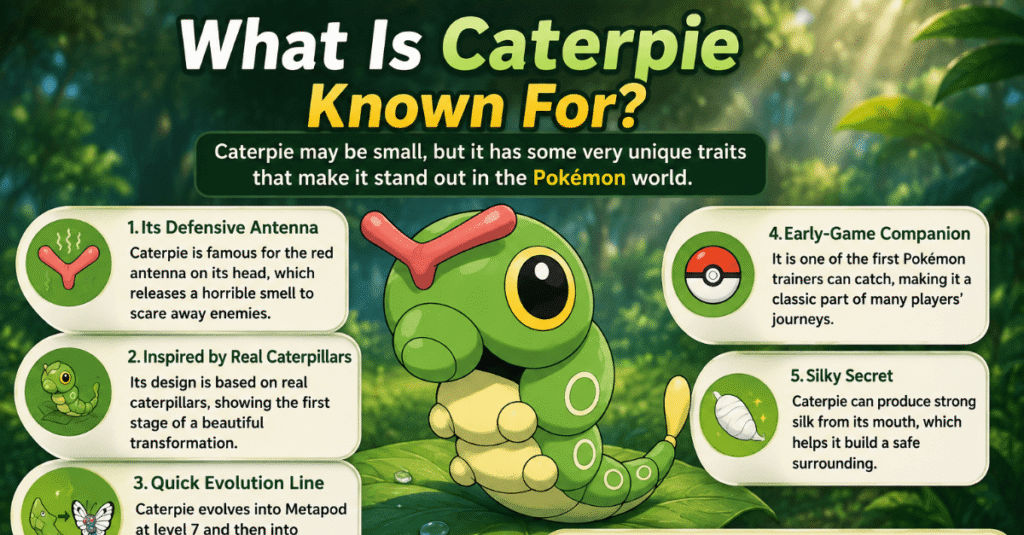
Despite its harmless appearance, Caterpie has a useful defensive feature. The official Pokédex explains that the antenna on its head can release a horrible stench that helps drive enemies away. Its short feet are also equipped with suction pads, allowing it to climb slopes and walls with ease.
What Type Is Caterpie?
Caterpie is a pure Bug-type Pokémon. That means it does not have a secondary type in its first form. According to the official Pokédex, Caterpie is weak to Fire, Flying, and Rock-type attacks.
Its Bug typing fits its design and behavior particularly well. Caterpie is built around the idea of a young insect developing through several stages. Rather than being designed as a powerful fighter from the start, it represents the early stage of a much larger transformation.
What Does Caterpie Look Like?
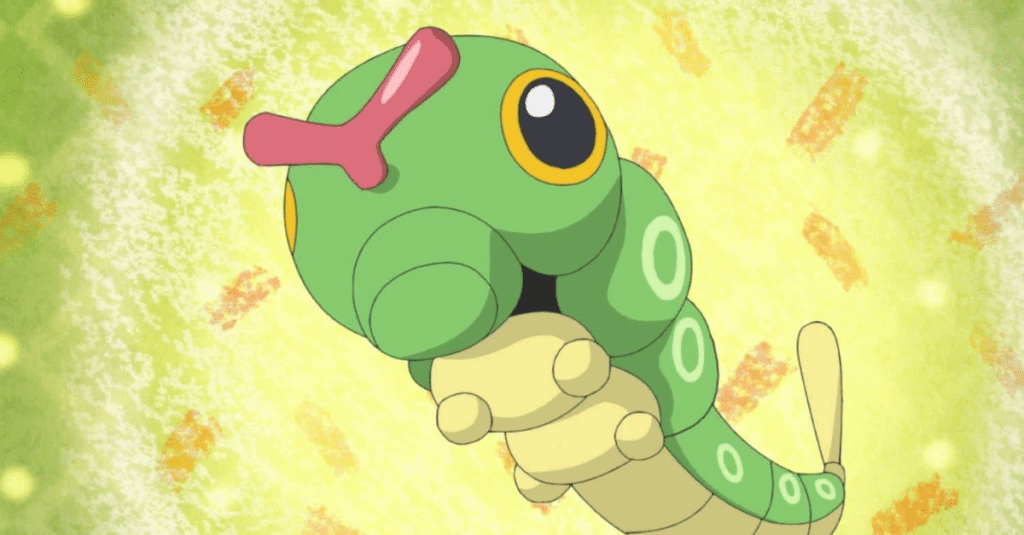
Caterpie has a bright green body that resembles a real caterpillar. Its most noticeable feature is the red antenna-like structure on its head, which is connected to its defensive behavior. The Pokémon also has yellow markings along its body and small feet that help it move across different surfaces.
There is something appealing about Caterpie’s design because it does not try to make a small creature look intimidating. Its large eyes and rounded body give it a friendly appearance, while the unpleasant smell produced by its antenna adds a clever defensive twist. That contrast is part of what makes Caterpie memorable.
Caterpie Evolution: From Caterpie to Metapod
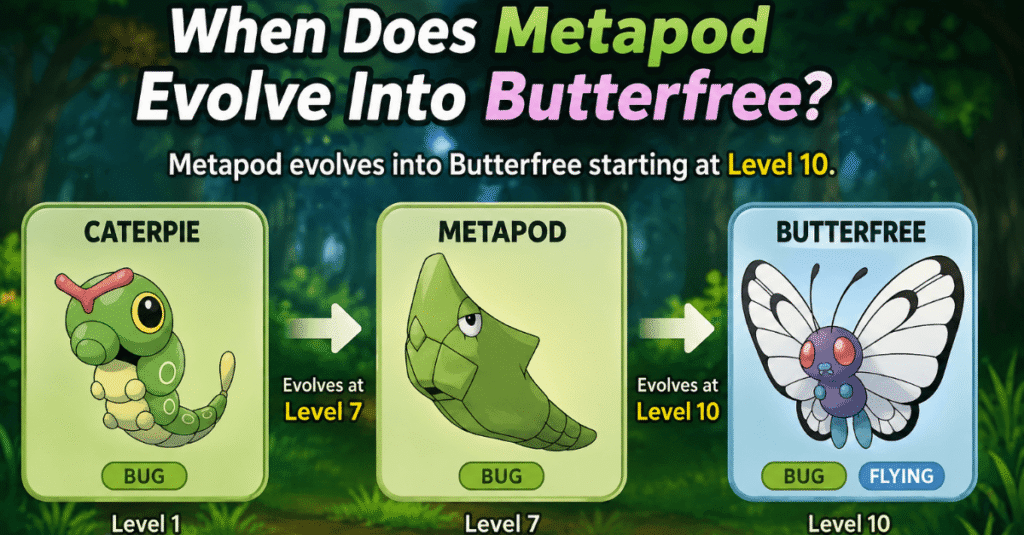
One of the biggest reasons trainers pay attention to Caterpie is its quick evolutionary path. Caterpie evolves into Metapod starting at level 7. This is the first major step in its development.
Metapod looks dramatically different from Caterpie. Instead of the active, crawling form, Metapod takes on a hardened cocoon-like appearance. This change reflects the familiar transformation that occurs in many insects in the real world. For players, seeing Caterpie evolve so early can also make it a practical choice during the opening part of a Pokémon adventure.
When Does Metapod Evolve Into Butterfree?
The next step happens quickly. Metapod evolves into Butterfree at level 10. This completes the three-stage evolutionary family: Caterpie becomes Metapod, and Metapod becomes Butterfree.
Butterfree is a Bug/Flying-type Pokémon, so the final form is considerably different from the original Caterpie. The transformation from a small crawling Pokémon into a winged Pokémon is one of the clearest examples of the series using evolution to represent growth and change.
What Abilities Does Caterpie Have?
Caterpie’s standard Ability is Shield Dust. The Ability protects it from the additional effects of damaging moves. In practical terms, when a damaging move has a secondary effect, Shield Dust can prevent that extra effect from affecting Caterpie.
Caterpie can also have Run Away as its Hidden Ability. Run Away is different from Shield Dust because its purpose is connected to escaping from wild battles rather than blocking secondary effects during attacks. Current ability references list Caterpie with Shield Dust as its regular Ability and Run Away as its Hidden Ability.
How Does Shield Dust Help Caterpie?
Shield Dust is a particularly fitting Ability for a Bug-type Pokémon. It prevents additional effects from damaging moves, meaning effects such as certain chances to cause a status condition or make the Pokémon flinch can be blocked. It does not simply make Caterpie immune to damage, however; the main attack can still hurt it.
That distinction is important. Shield Dust is about removing the unwanted extra effect of an attack, not reducing the basic damage of the move. It gives Caterpie a small defensive advantage without turning it into a powerful defensive Pokémon.
What Is Caterpie Known For?
Caterpie is especially known for its antenna and defensive odor. Rather than relying entirely on strength, it can discourage predators by releasing an unpleasant smell. The official Pokédex specifically describes this behavior as a method of protection.
It is also known for its fast evolutionary journey. A newly caught Caterpie can become Metapod at level 7 and Butterfree at level 10, making its development noticeable very early in many Pokémon adventures.
Is Caterpie Good to Train?
For a player starting a Pokémon journey, Caterpie can be a worthwhile Pokémon to train, particularly because its evolutionary levels are low. Reaching Butterfree does not require an extremely long period of leveling compared with some slower-evolving Pokémon.
Caterpie itself is not designed to dominate difficult battles, and its Bug typing gives it several weaknesses. Its real appeal is the journey from a tiny beginner Pokémon into Butterfree. For new players, that quick progression can make Caterpie an enjoyable member of an early-game team.
Caterpie and Its Connection to the Natural World
The charm of Caterpie comes partly from how closely its design reflects a real caterpillar. The Pokémon world often borrows ideas from animals, plants, mythology, and everyday objects, and Caterpie is a straightforward example of that approach.
Its evolutionary line also follows a familiar biological idea: a crawling larval stage changes into a cocoon-like form before becoming a winged adult. Pokémon does not attempt to reproduce real insect biology exactly, but Caterpie’s progression makes the concept easy for players to understand.
Caterpie vs. Metapod vs. Butterfree
The three Pokémon in this evolutionary family have very different roles and appearances. Caterpie represents the young, active stage. Metapod is the protective middle stage, while Butterfree becomes the fully developed flying form.
Their types also show an important change. Caterpie and Metapod are Bug-type Pokémon, while Butterfree is Bug/Flying. The official Pokédex lists all three together as Caterpie’s evolutionary family.
Frequently Asked Questions About Caterpie
What number is Caterpie in the Pokédex?
Caterpie is National Pokédex #0010.
What type is Caterpie?
Caterpie is a Bug-type Pokémon.
What does Caterpie evolve into?
Caterpie evolves into Metapod, which later evolves into Butterfree.
What level does Caterpie evolve?
Caterpie evolves into Metapod starting at level 7.
What level does Metapod evolve into Butterfree?
Metapod evolves into Butterfree starting at level 10.
What is Caterpie’s Ability?
Caterpie’s standard Ability is Shield Dust.
Does Caterpie have a Hidden Ability?
Yes. Caterpie’s Hidden Ability is Run Away.
What is Caterpie weak against?
Caterpie is weak to Fire, Flying, and Rock-type moves.
Why does Caterpie have an antenna?
Its antenna has a defensive purpose: Caterpie can release a strong, unpleasant stench from it to discourage enemies.
Is Caterpie worth training?
Caterpie can be a fun choice, especially for beginners, because it evolves quickly and eventually becomes Butterfree. Its usefulness depends on the particular game and the rest of the team.
Final Thoughts on Caterpie
Caterpie may be one of the smallest and simplest Pokémon in the original Pokédex, but its place in the series is easy to appreciate. It combines a recognizable insect-inspired design with a clever defensive feature, useful early-game progression, and one of the franchise’s most straightforward evolutionary stories. Starting at #0010, Caterpie develops into Metapod at level 7 and then Butterfree at level 10, giving trainers a clear sense of progression from the moment they catch it.
For many players, Caterpie is more than just another early Bug-type Pokémon. It represents the idea that a small beginning can lead to a very different final form. That simple journey is a big part of why Caterpie remains recognizable and memorable among the original Pokémon.
Read more: Pokémon Pokédex: The Complete Guide to Every Pokémon

One thought on “Caterpie Explained: Evolution, Abilities, and Interesting Facts”