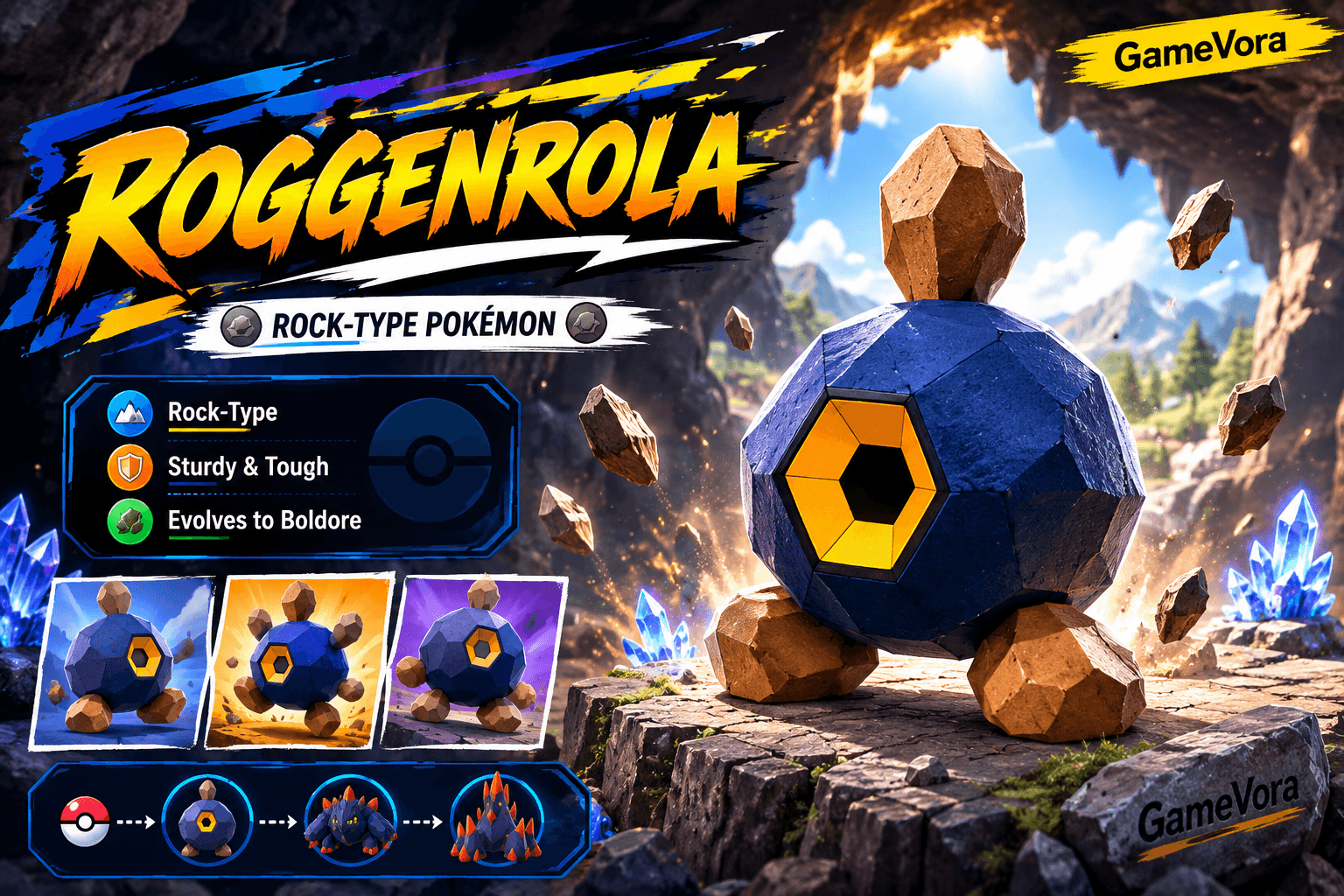
Most trainers walk right past Roggenrola in a cave without giving it a second thought. It looks like just another rock sitting in the dark, easy to ignore next to flashier Pokémon. But if you take a closer look, this small Rock-type has one of the more interesting origin stories in the Unova region, along with a few quirks that make it stand out once you know where to look. It’s not a Pokémon built for headlines, and that’s kind of the point. It rewards the players who actually stop and pay attention.
| Quick Bio | Details |
|---|---|
| Name | Roggenrola |
| Type | Rock |
| Category | Mantle Pokémon |
| Generation | V (Black and White) |
| Evolves Into | Boldore (Level 25) → Gigalith (Trade) |
| Ability | Sturdy |
| Height | Around 1’4″ (0.4 m) |
| Weight | Roughly 39.7 lbs (18 kg) |
What Is Roggenrola?
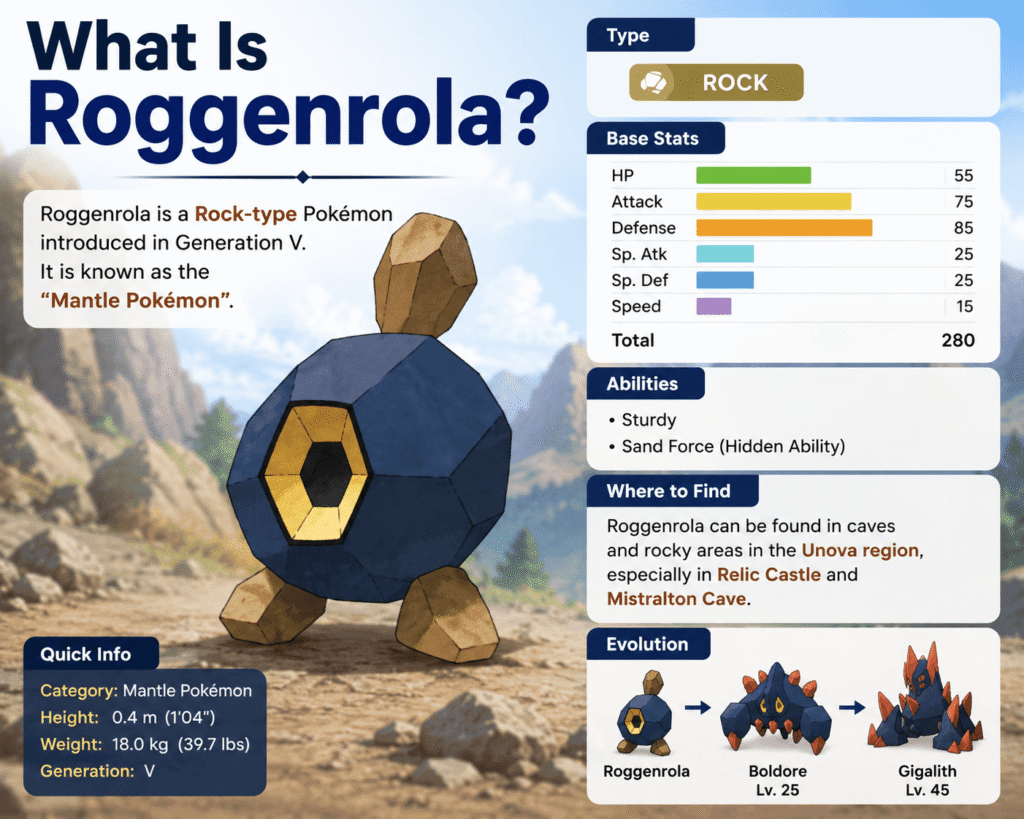
Roggenrola is a Rock-type Pokémon that first appeared in Generation V, introduced alongside Pokémon Black and White. It’s classified as the Mantle Pokémon, a nod to the deep underground layers it’s associated with. Visually, it’s small and roughly spherical, with a navy blue body covered in smooth, flat facets that make it look almost gem-like despite its rugged nature. In the center of its body sits a yellow hexagonal opening that actually functions as its ear, not an eye, which surprises a lot of people the first time they read its Pokédex entry. On top of its head is a brown, oblong rock, and it has similarly rocky, stubby feet that give it just enough mobility to move around without looking anything like a typical creature.
Roggenrola holds a modest spot in the Unova Pokédex, usually encountered in caves, and it’s often one of the first Rock-types trainers run into during their journey through the region. It doesn’t demand much attention early on, but its role becomes clearer once you understand its evolutionary line and what it’s capable of later.
The Backstory Behind Roggenrola
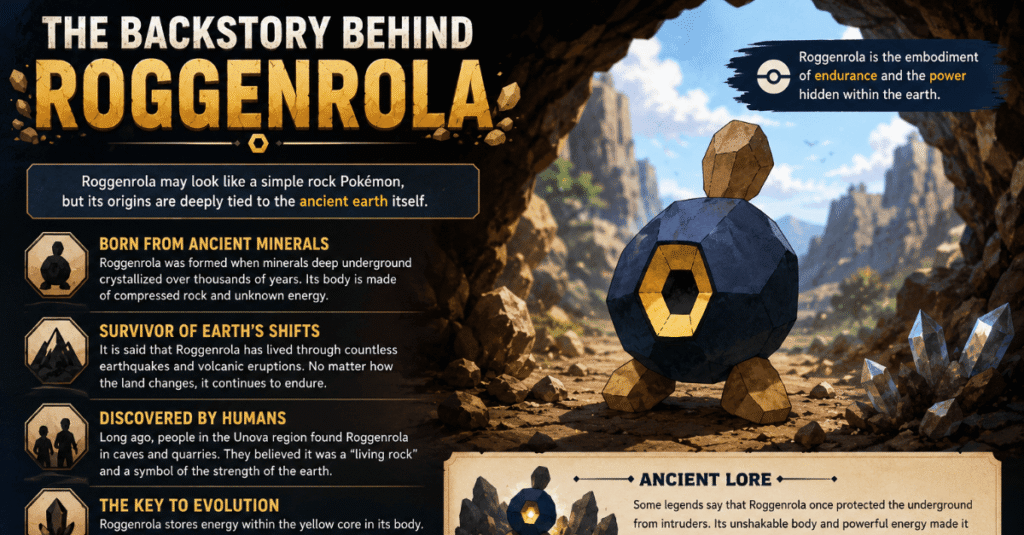
What makes Roggenrola genuinely interesting is its origin story, something that goes a little deeper than most early-game Pokémon get. According to its lore, Roggenrola was first discovered roughly a century ago, found lodged inside an earthquake fissure within a layer of exposed rock deep underground. That detail alone gives it more narrative weight than most Pokémon of its stature.
Its body is said to be composed of dirt compressed over the course of many centuries, which is part of why it’s often compared directly to Geodude and Carbink, two other Pokémon known for their incredibly hard, mineral-based bodies. Despite how solid and unyielding it appears, there’s a strange soft spot in the lore: if Roggenrola is left to soak in water for a long enough period, its normally steel-hard body will actually begin to soften. It’s a small detail, but it adds a layer of vulnerability to a Pokémon that otherwise seems built like a boulder.
This underground origin also explains its temperament. Roggenrola isn’t aggressive by nature, but it doesn’t do particularly well when exposed to light for extended periods, since its body and behavior are built around a life spent mostly in complete darkness.
Roggenrola’s Evolution Line
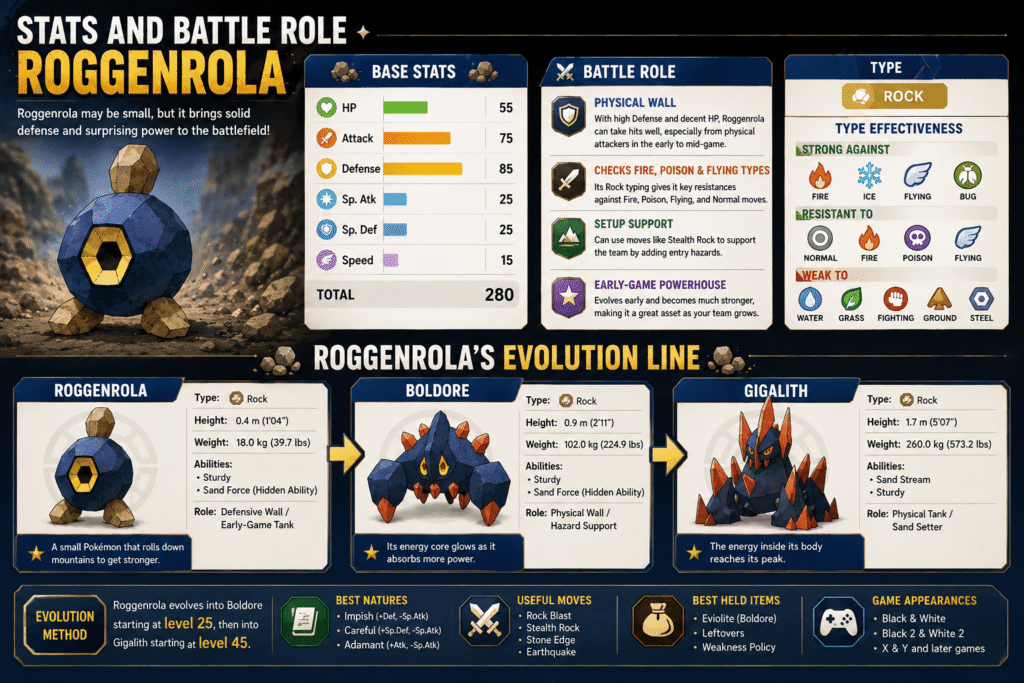
The evolutionary path for Roggenrola follows a pattern that’s fairly common among Rock-types, but it’s still worth breaking down clearly. Roggenrola evolves into Boldore starting at level 25. From there, Boldore evolves into its final form, Gigalith, but only through trading, not through leveling up. This means solo players who want a fully evolved Gigalith will need to either trade with a friend or work out a trade-back arrangement, since there’s no way to reach that final stage by grinding levels alone.
Each stage in this line grows noticeably larger and more heavily armored. Roggenrola is small and compact, Boldore becomes bulkier with more visible rock plating, and Gigalith turns into a genuinely massive, tank-like Pokémon covered in thick rocky armor. The physical transformation mirrors the stat growth, with each evolution leaning further into raw physical power and defense rather than speed or special attacks.
Stats and Battle Role
In terms of competitive value, Roggenrola is not going to win any awards for balance. Its stat spread leans heavily into physical attack and defense, with base stats around 75 Attack and 85 Defense, numbers that are genuinely solid for a Pokémon still in its early evolutionary stage. The problem shows up on the special side, where its Special Attack and Special Defense both sit at a base of only 25, among the lowest in the entire series, tied closely with Pokémon like Metapod and Jigglypuff in that particular category.
Roggenrola is also tied with Rockruff and Nacli for having the lowest overall base stat total among all Rock-type Pokémon, which says a lot about where it fits in the bigger picture. It’s not a Pokémon built for early dominance. Its real value comes later, once it evolves into Boldore and eventually Gigalith, where that early physical bulk starts to actually mean something in battle.
Its primary ability, Sturdy, allows it to survive an attack that would otherwise knock it out in one hit, as long as it’s at full health beforehand. This gives Roggenrola a small but genuinely useful trick in the early game, letting it act as a temporary wall even when its stats aren’t particularly impressive yet.
Roggenrola in Pokémon Go
For players engaging with Roggenrola through Pokémon Go rather than the mainline games, the mechanics work a little differently. Instead of leveling up, Roggenrola evolves into Boldore after being fed 50 candies, and its final evolution remains Gigalith, following the same three-stage structure as the core series.
Roggenrola has also received both Shiny and Shadow variants within Pokémon Go, giving collectors extra reasons to track it down beyond just filling out a basic Pokédex entry. Its inclusion in various in-game events over time has kept it relevant to players who might otherwise skip over such a low-key Rock-type.
Interesting Trivia About Roggenrola
There are a handful of details about Roggenrola that don’t fit neatly into stats or evolution charts, but they’re worth knowing anyway.
Is Roggenrola used for anything unusual in its lore? Yes, actually. Within the Unova region, there’s a televised bowling program that uses Roggenrola in place of actual bowling balls. Depending on the individual Roggenrola involved, there’s apparently a genuine risk of it exploding mid-game, which is a strange and slightly chaotic detail for a Pokémon that otherwise seems fairly calm.
Where does the name Roggenrola come from? The English name is thought to be a blend of “rock” and “rock and roll,” or possibly a nod to “rock-and-roller,” fitting for a Pokémon shaped like a rolling boulder. Its Japanese name, Dangoro, likely combines “dango,” a type of Japanese dumpling, with “goro goro,” an onomatopoeia used to describe the sound of a boulder rolling along the ground.
Does Roggenrola have any unique physical traits compared to other Generation V Pokémon? It does. Roggenrola is often pointed out as the only Pokémon from Generation V that’s built entirely from just a head and legs, without any arms or hands at all, which sets it apart visually from most of its generation.
Why does Roggenrola’s ear turn red as a Shadow Pokémon? Even though the hexagonal opening on its body technically functions as an ear rather than an eye, it still shifts to a reddish color when Roggenrola becomes a Shadow Pokémon in Pokémon Go, following the same visual pattern used for other Shadow Pokémon in the game.
Final Thoughts on Roggenrola
Roggenrola isn’t the kind of Pokémon that shows up in highlight reels or gets picked first in a battle. It’s quiet, a little overlooked, and easy to underestimate at a glance. But once you dig into where it comes from, how it evolves, and the strange little details tied to its lore, it becomes clear that there’s more personality packed into this small rock than most players ever notice. If you’re working your way through Unova and see one sitting in a cave, it might be worth grabbing. Give it time to grow into Boldore, and eventually Gigalith, and you’ll end up with a genuinely tough Pokémon that started out as nothing more than a forgotten piece of ancient, compressed earth.
Read more: gamevora.co.uk
One thought on “Roggenrola: The Little Rock Pokémon With a Surprising Backstory”